Military capability
North Korea’s military in 2026
A huge share of a tiny economy goes to the military, and since 2017 that has bought a real nuclear arsenal. All numbers are public estimates, and the sources often disagree.
Nuclear weapons
Six tests between 2006 and 2017, all at Punggye-ri. Plutonium comes from the Yongbyon reactors, enriched uranium from Yongbyon and the covert Kangson site. Since 2023 nuclear status is written into the constitution, and Kim Jong Un has called for "exponential" growth.
- 2006Oct 9First test
- 2009May 25
- 2013Feb 12
- 2016Jan 6Claimed H-bomb
- 2016Sep 9
- 2017Sep 3Likely thermonuclear
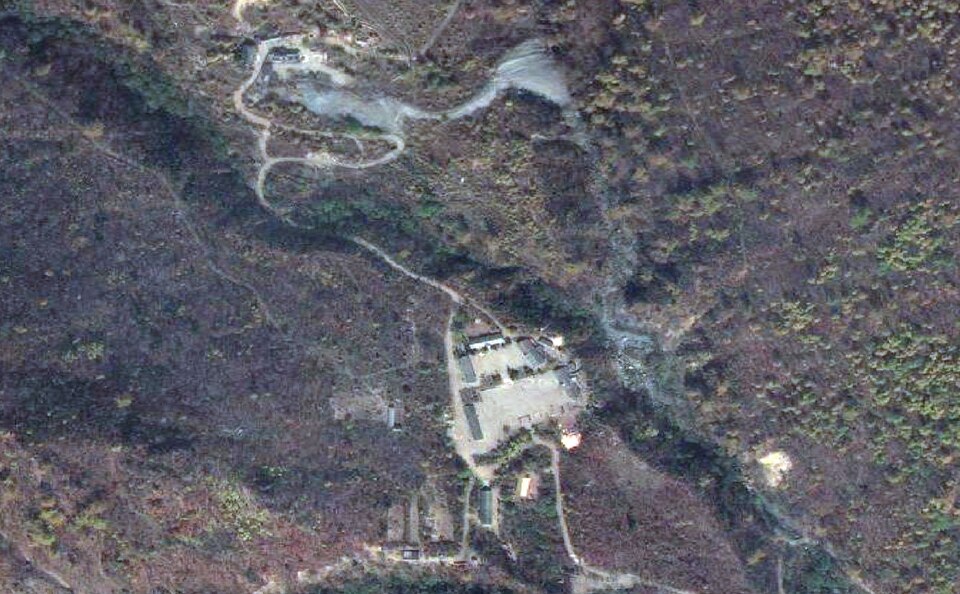 NuclearPunggye-ri nuclear test site
All six nuclear tests (2006-2017) happened here. Tunnels were blown up for cameras in 2018, then repaired.
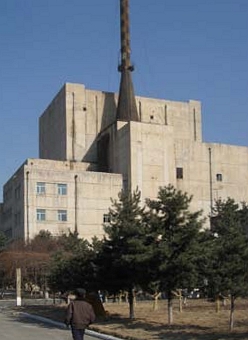 NuclearYongbyon nuclear complex
The heart of the nuclear program: reactors that make plutonium, a reprocessing plant and a uranium enrichment hall.
© Esri, Maxar NuclearKangson enrichment site
Suspected covert uranium enrichment plant near Pyongyang. Kim Jong Un visited an enrichment facility in 2024 in a rare public photo-op.
Missiles
Every class from short range to intercontinental. The big shift is solid fuel: those missiles can be hidden and fired in minutes, so they are much harder to destroy before launch.
Distances are straight-line from Pyongyang. Square-root scale so short-range missiles stay visible.
- ICBM, solid fuelAll of the USHwasong-18Hwasong-19
Minutes to launch instead of hours. Hwasong-19 first flew in October 2024.
- ICBM, liquid fuel13,000+ kmHwasong-15Hwasong-17
Hwasong-17 is one of the largest road-mobile missiles in the world.
- IRBM / hypersonic~4,500 kmHwasong-12Hwasong-16B
Hwasong-16B carries a hypersonic glide vehicle meant to dodge missile defenses.
- Submarine-launched1,000–2,000+ kmPukguksong series
Built and tested at the Sinpo shipyard. Few real submarines to carry them yet.
- Cruise1,500–2,000 kmHwasal-1Hwasal-2
Low-altitude cruise missiles, claimed nuclear-capable.
- Short range300–800 kmHwasong-11 (KN-23/24)KN-25
Low-flying, maneuvering missiles aimed at South Korea and Japan. Fired at Ukraine by Russia.
357 missile tests since 1984 CNS database
Explore every testSRBM MRBM IRBM ICBM SLBM HGV Space launch
Conventional forces
Why there is no military option
Much of the equipment is Soviet-era, fuel and food are short, and soldiers often work as construction and farm labor. What matters is artillery: thousands of guns and rocket launchers in hardened positions near the DMZ, in range of Seoul. That threat, more than the nukes, is why invasion has never been on the table.
The war in Ukraine
Since late 2024 North Korea has sent more than 20,000 troops to Russia, mainly to the Kursk region. A 2024 mutual defense treaty formalized the alliance.
North Korea sends
- 20,000+ troops mostly to Kursk
- Millions of artillery shells
- Hwasong-11 missiles fired at Ukrainian cities
Russia gives back
- Money
- Food
- Oil
- Possibly tech satellites, submarines, air defense
Its soldiers are also getting real combat experience with drones, which no other army in Asia has.
Cyber and crypto theft
Hacking groups often called Lazarus steal crypto on a scale no one else does. Thousands of North Korean IT workers also hold remote jobs at foreign companies under fake identities. UN experts say the money funds the weapons programs.
Why this matters for freedom
The weapons are the regime’s insurance against outside pressure, and they cost money that could feed people. Every dollar from crypto theft or arms sales to Russia keeps the elite loyal without reform. Cutting that income is one of the realistic levers.
How North Korea could be freed →Sources
- SIPRI Yearbook 2026sipri.org ↗
- IISS, The Military Balanceiiss.org ↗
- North Korean troops in Kursk, 2026kyivindependent.com ↗
- HUR casualty estimatekyivindependent.com ↗
- CSIS Missile Threat: North Koreamissilethreat.csis.org ↗
- CNS Missile Test Databasenti.org ↗
- Nuclear tests of North Koreaen.wikipedia.org ↗



Last reviewed 2026-10-02.